Back office outsourcing helps maritime companies scale faster by offloading non-core operations like accounting, compliance documentation, payroll, and fleet reporting to specialized teams. This reduces overhead, improves accuracy, ensures regulatory compliance, and frees leadership to focus on fleet expansion, chartering, and profitability instead of paperwork.
The short version
- Maritime companies scale faster when admin work doesn’t slow vessels, crews, or cash flow
- Outsourcing back-office functions cuts fixed costs and converts them to flexible capacity
- Compliance-heavy tasks are handled by specialists who understand maritime regulations
- Leadership gains time to focus on routes, charters, safety, and growth decisions
- Well-run outsourcing improves accuracy, audit readiness, and operational visibility
The real issue that most maritime companies don’t say out loud

I’ve worked around shipping and maritime-adjacent businesses long enough to notice a pattern.
The vessels scale faster than the office does.
A company adds two new ships…
Crew rotations increase…
Invoices double…
Compliance filings pile up…
And suddenly, the back office becomes the bottleneck.
Not storms.
Not fuel prices.
Not port congestion.
Paperwork.
And the truth is, most maritime leaders didn’t get into this industry because they love reconciliations, payroll cycles, or document control systems. They got in to move cargo, managing fleets, and growing profitable routes.
This is where back office outsourcing quietly becomes a growth lever, not a cost-cutting trick.
What does “back office outsourcing” actually mean in the maritime world?
Before we go further, let’s be clear. In maritime, back office outsourcing is not generic admin support.
It’s specialized operational support that understands shipping realities, such as:
- Vessel accounting and voyage P&L
- Crew payroll across jurisdictions
- Compliance documentation tied to maritime law
- Vendor and port agent payments
- Insurance, claims, and reporting workflows
- Fleet performance reporting
- Customs and shipping documentation processing
This isn’t the same as outsourcing a call center.
Maritime back office teams deal with time zones, port deadlines, multi-currency invoices, and regulations set by bodies like the International Maritime Organization.
If they miss something, ships don’t move. Or worse, companies get fined.
Why back office work becomes the hidden scaling problem
Here’s a real-world scenario I’ve seen more than once.
A regional shipping operator grows from 6 vessels to 14 in under two years. On paper, that’s success.
But behind the scenes:
- Accounting closes take twice as long
- Crew payroll errors increase
- Compliance filings are rushed
- Management reports arrive late
- Senior staff spend weekends fixing spreadsheets
The fleet scales linearly.
The admin load scales exponentially.
Most maritime companies try to solve this by:
- Hiring internally (slow and expensive)
- Overworking existing staff (burnout)
- Adding software without process redesign (chaos)
Outsourcing flips this equation.
How outsourcing directly accelerates maritime growth

1. It removes fixed-cost drag during expansion
Scaling internally means:
- Salaries
- Benefits
- Office space
- Training time
- Turnover risk
Outsourcing converts those fixed costs into variable ones.
You can scale support up or down as vessels are added or redeployed without long-term payroll commitments.
This matters in shipping, where routes, contracts, and demand can shift quickly.
2. Specialized teams reduce costly mistakes
Maritime back offices aren’t forgiving environments.
One missed compliance filing tied to SOLAS requirements can delay a vessel.
One payroll error can ground crew morale.
One misclassified invoice can distort voyage profitability.
Outsourced maritime back office providers live inside these systems daily. They’re built to handle:
- Multi-currency accounting
- Maritime-specific chart of accounts
- Flag state reporting
- Audit-ready documentation
That specialization prevents errors that slow scaling.
3. Leadership gets time back and this is the real multiplier
Let me be blunt.
Most maritime companies don’t fail because of bad strategy. They stall because leadership is buried in operations.
When founders, CFOs, or operations directors spend:
- Evenings fixing reports
- Mornings chasing documents
- Weekends reviewing payroll
Growth decisions get delayed.
Outsourcing gives leadership mental bandwidth back and that’s where scaling actually happens.
Which back office functions maritime companies outsource first
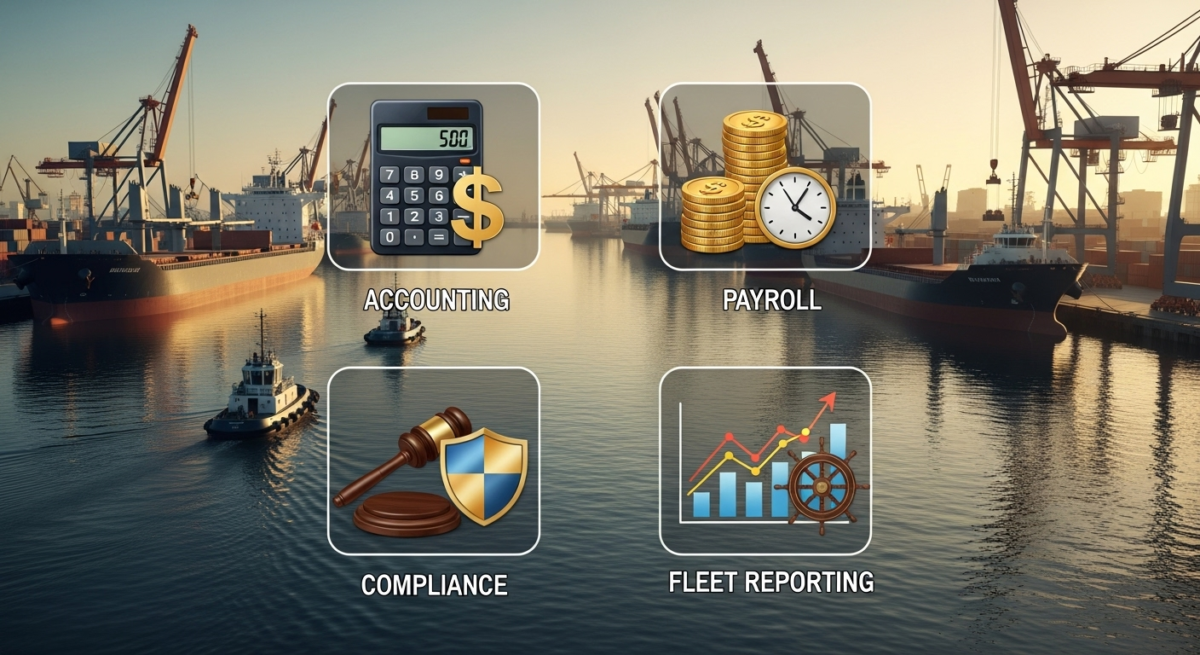
Accounting & finance operations
- Accounts payable/receivable
- Voyage accounting
- Cost allocation per vessel
- Monthly closes and reporting
- Multi-currency reconciliations
This is usually the first function outsourced because it’s measurable and high-impact.
Crew payroll & HR administration
Crew payroll is uniquely complex:
- Different flags
- Different tax rules
- Different rotation schedules
Outsourcing this removes risk and improves accuracy fast.
Compliance & documentation
This includes:
- Safety documentation tracking
- Insurance documentation
- Audit preparation
- Regulatory filings aligned with maritime authorities
Missing deadlines here doesn’t just cost money it damages reputation.
Fleet performance & management reporting
Outsourced teams often build standardized dashboards that show:
- Vessel profitability
- Cost per voyage
- Utilization metrics
- Fuel and port cost trends
This turns raw data into scaling insight.
A simple comparison: in-house vs outsourced back office
| Area | In-House Team | Outsourced Back Office |
| Cost structure | Fixed, rising | Variable, scalable |
| Hiring speed | Slow | Immediate |
| Maritime expertise | Depends on hires | Built-in |
| Coverage | Limited by staff | Redundant teams |
| Compliance risk | Higher | Lower |
| Leadership time | Consumed | Protected |
This table doesn’t tell the full story, but it highlights why fast-growing maritime firms shift early.
Common fears and the reality
“We’ll lose control”
In practice, strong outsourcing increases visibility.
Dashboards improve. Reports standardize. SLAs define accountability.
Control becomes clearer, not looser.
“They won’t understand our business.”
Good maritime outsourcing providers don’t generalize. They specialize.
If they don’t understand charter parties, port charges, demurrage, or crew rotations that’s a red flag. Not the norm.
“It’s risky to trust outsiders.”
Here’s the uncomfortable truth:
Your biggest risk is internal overload.
Most errors happen when teams are stretched thin not when processes are structured and documented.
How outsourcing supports faster scaling — step by step
- Stabilizes operations so growth doesn’t break systems
- Improves accuracy in financial and compliance reporting
- Speeds decision-making with timely insights
- Reduces burnout among key staff
- Supports geographic expansion without hiring locally
- Keeps leadership focused on revenue and fleet strategy
Scaling stops being reactive. It becomes intentional.
When outsourcing makes the most sense
Outsourcing delivers the biggest impact when:
- Fleet size is growing faster than the admin staff
- Leadership spends too much time on reports
- Compliance requirements are increasing
- Expansion into new regions is planned
- Internal hiring can’t keep up with demand
If two or more apply you’re already feeling the drag.
The mistake to avoid when outsourcing back office work
I’ve seen companies fail at outsourcing for one simple reason:
They outsourced tasks, not processes.
They sent work out without:
- Clear SOPs
- Defined reporting structures
- Ownership on their side
Outsourcing works best when you treat it like an operational partnership—not a dumping ground.
What this really means for maritime growth
Here’s the part most people miss.
Outsourcing isn’t about saving money.
It’s about removing friction from growth.
When back office operations run cleanly:
- Ships move faster
- Decisions come quicker
- Cash flow is clearer
- Compliance stress drops
- Leadership can think long-term again
That’s how companies scale not by working harder, but by working cleaner.
FAQs
How does outsourcing help shipping companies grow?
Outsourcing helps shipping companies grow by reducing administrative overload, improving compliance accuracy, and giving leadership more time to focus on fleet expansion, chartering, and profitability instead of operational paperwork.
Is back office outsourcing safe for maritime companies?
Yes, when handled by maritime-specialized providers. These firms follow structured processes, security protocols, and regulatory standards designed for shipping operations, often reducing risk compared to overstretched internal teams.
What functions should maritime companies outsource first?
Most maritime companies outsource accounting, crew payroll, and compliance documentation first. These areas are complex, time-consuming, and highly regulated, making them ideal for specialized external teams.
Does outsourcing reduce operational control?
No. In most cases, outsourcing increases visibility through standardized reporting, dashboards, and service-level agreements that clarify responsibilities and performance metrics.
Can outsourcing support global maritime operations?
Absolutely. Outsourcing enables round-the-clock support across time zones, helping maritime companies manage global fleets without building local back offices in every region.
Is back office outsourcing only for large shipping companies?
No. Small and mid-sized maritime firms often benefit the most because outsourcing gives them enterprise-level support without enterprise-level overhead.
How long does it take to see results from outsourcing?
Many companies see improvements within 60–90 days, especially in reporting accuracy, compliance timelines, and leadership workload reduction.
Will outsourcing affect company culture?
Only if it’s handled poorly. When done right, internal teams focus on higher-value work, which often improves morale instead of hurting it.
Can outsourced teams adapt to our internal systems?
Yes. Reputable providers work inside your accounting platforms, fleet management tools, and documentation systems rather than forcing new software immediately.
What’s the biggest risk of outsourcing back office operations?
The biggest risk is choosing a provider without maritime expertise. Industry knowledge matters more than price.
Final takeaway
If your fleet is growing but your back office feels stretched, that’s not a failure.
It’s a signal.
Maritime companies that scale fastest don’t do everything themselves. They build systems that let ships move while paperwork stays invisible.
And outsourcing done properly is one of the cleanest ways to get there.